
Together time
Take a seven-frame photography date
A practical 45-minute photo walk with seven prompts, privacy checks, and one contact sheet to keep.
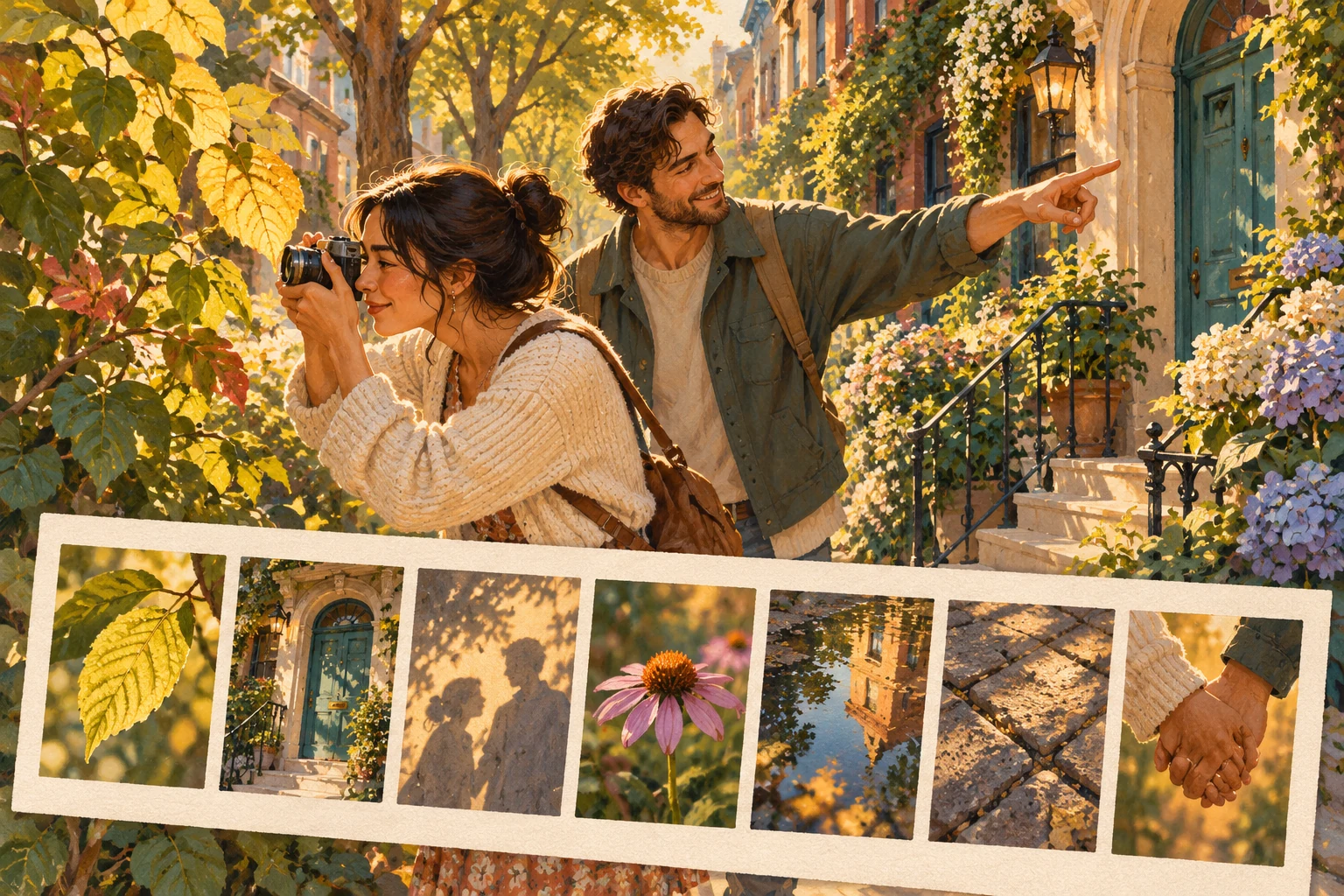
Make seven frames the whole date
This photography date idea turns a walk into a small shared project: make exactly seven final photographs, then arrange them as a contact sheet or a simple numbered note. A limit keeps the activity finishable and gives each picture a job. You need a phone or camera, a route you can comfortably cover, and about 45 minutes.
Agree that this is an observation game, not a test of camera skill. Blurry, crooked, or oddly framed photographs can stay if they hold the detail you meant to notice. The goal is to leave with seven specific memories of one stretch of time together.
Choose a route with a clear ending
Pick a short loop around a block, a public garden path, a market aisle where photography is allowed, or several rooms at home. Name the finish point before you begin: a bench, the front door, or a table where you can review the results. A defined ending prevents the walk from becoming an open-ended search for a perfect shot.
Match the route to energy, mobility, weather, light, and local rules. An indoor version can move from window to kitchen to bookshelf. A stationary version can be made from one seat by changing direction, distance, and subject rather than location.
Set the privacy rule first
Before the first frame, agree not to photograph identifiable strangers, children, license plates, private windows, access codes, or anything either person does not want shared. If a person will be recognizable, ask before taking the picture and again before sharing it.
Treat every photograph as private unless both people choose otherwise during the review. This keeps the date focused on noticing together and avoids turning a relaxed activity into an unplanned public post.
Frames one and two: threshold and repetition
For frame one, photograph a threshold: a gate, doorway, curb, shadow line, or the place where one material meets another. Let the frame show both sides of the boundary. At home, a cupboard door or the edge of a rug works just as well.
For frame two, find a repeated shape. Look for a row of windows, stacked cups, leaves with similar outlines, or tiles that make a rhythm. Do not rearrange a public place; change your viewpoint until the repetition becomes clear.
Frames three and four: bright detail and paired shadows
For frame three, find the smallest bright thing you can both see: a colored label, a reflection, a berry, or a thread. Photograph enough of its surroundings to show why it caught your attention.
For frame four, make two shadows share a frame. They can come from the two of you, two household objects, or two plants. If there is no direct light, reinterpret the prompt as two dark shapes or reflections.
Frames five and six: landmark and evidence of time
For frame five, treat an ordinary object as a landmark. A mailbox, kettle, bicycle rack, or worn step can fill the role. Try a lower or closer viewpoint, but stay on permitted paths and keep equipment out of other people’s way.
For frame six, photograph evidence of time: fading paint, a half-finished drink, a long shadow, a growing plant, or something repaired. The image does not need to explain itself fully; each person can add one sentence during the review.
Frame seven belongs to both of you
Stop and choose the last subject together. One person can select what belongs in the frame while the other chooses the distance or angle, then swap if you want a second attempt. Keep only the version you agree will be frame seven.
This final photograph is the only prompt that requires a joint decision. It gives the series a deliberate ending without making every earlier choice into a negotiation.
Leave the place as you found it
When the date is outdoors, photograph details without picking flowers, moving natural objects, approaching wildlife, blocking a path, or disturbing other visitors. The National Park Service’s Leave No Trace guidance includes leaving what you find, respecting wildlife, and being considerate of other visitors.
If a prompt seems to require staging, move yourself or the camera instead of the scene. At home, return any moved objects when the photograph is finished so the activity does not create a cleanup project.
Review without scoring
At the finish point, look only at the seven chosen frames. Take turns completing two sentences for each one: “I noticed…” and “I want to remember…”. Do not rank the photographs or compare camera quality.
Each person then chooses one frame to caption. A useful caption can be literal, such as “blue thread on the third step,” or personal, such as “the point where we turned back.” Keep both captions even if they describe the same image differently.
Check location details before sharing
Photos can contain or display location information. Apple provides controls for managing location metadata and for sharing a photo without its location, while Google Photos lets people review, edit, or remove certain saved locations and control whether location is shared. Check the guidance for the device and service you actually use rather than assuming a messaging app removes the information.
Also crop out notifications, names, addresses, and reflections that were easy to miss during the walk. If either person is uncertain, keep the seven-frame set private.
Keep one compact artifact
Make a simple contact sheet, album, or numbered note containing frames one through seven and the two selected captions. Title it with the place and date. The small, fixed format makes it easy to revisit without sorting a large camera roll.
For a long-distance version, use the same prompts in separate locations and compare one frame at a time on a call. Keep each person’s seven images as its own sequence before pairing matching prompts; the differences are part of the story.
How this fits Little Together
Little Together is still in development. The current prototype explores local care, a home, a garden, and intentional memories. Partner perspectives in the prototype are simulated; remote care, accounts, and invitations are planned rather than available.
The seven-frame date is a real-world activity you can do now, not an announcement of a photo feature. App, download, and play links remain Coming soon.
A little more to explore
 Together time
 · 19 Oct 2026
Build a five-senses indoor picnic date
A practical 60-minute indoor picnic with a simple menu, five sensory prompts, and one small map to keep.
A little read ↗ Together time
 · 18 Oct 2026
Paint one shared scene on two canvases
A practical 75-minute painting date using one shared palette, two adjoining pictures, and a no-critique reveal.
A little read ↗