
Together time
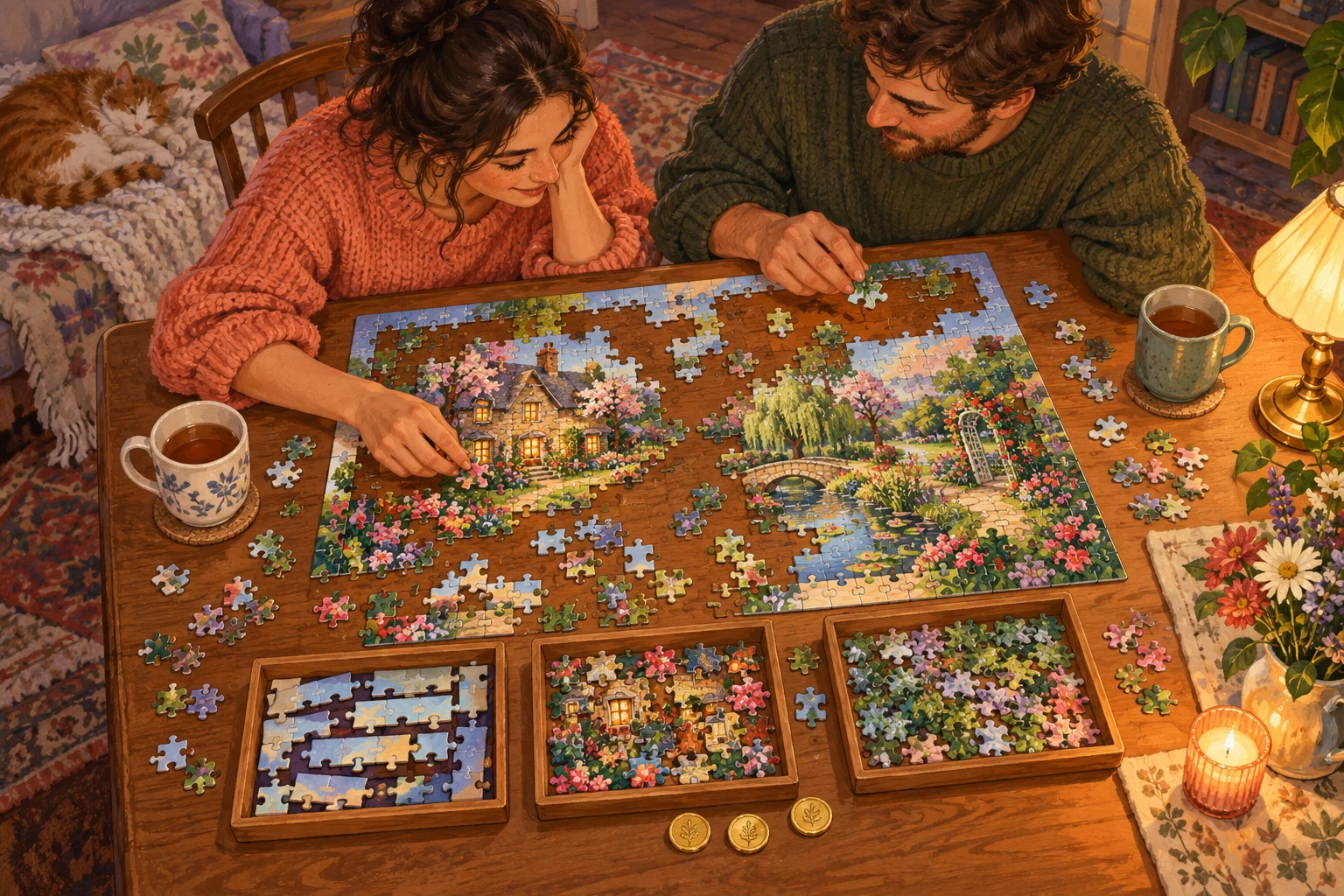
Plan a cooperative puzzle date with three shared piles
A practical puzzle date night with a three-pile setup, clear turn-taking, three hints, and an easy digital version.
Make the puzzle a shared project
A puzzle date night needs one image, one work surface, and a finish line that fits the evening. Choose a jigsaw you already own or a legal digital puzzle, then set a 45- to 75-minute window. The date can end when the picture is complete or when the timer ends.
Agree that the aim is to build one picture together, not to measure who places more pieces. Leave phones aside except for the timer, instructions, or the digital puzzle itself.
Choose a picture before choosing difficulty
Pick an image that gives both people several recognizable anchors: a bold object, a patch of text, a repeated pattern, or a clear horizon. A beautiful image with few distinct areas can be harder to share than a busier one with obvious landmarks.
Then choose a piece count or digital setting that suits the available time and energy. Smithsonian Libraries and Archives publishes digital jigsaw puzzles featuring collection images and notes that its puzzles can be adjusted for different skill levels.
Set one visible stopping rule
Write the stopping rule on a note: finish the puzzle, complete the outer frame plus three landmarks, or stop when the timer rings. A partial picture is still a complete date when the boundary was chosen in advance.
If the puzzle is unfamiliar, use the frame-and-three-landmarks option. It offers several satisfying endpoints without requiring a late-night push through a difficult sky or background.
Sort into three shared piles
Turn all pieces face up, then make only three piles: Edge, Anchor, and Bridge. Edge holds pieces with a straight side. Anchor holds pieces clearly connected to a notable object or pattern. Bridge holds everything that may connect regions later.
Keep the piles between both people rather than assigning ownership. A piece can move between piles whenever new information appears; sorting is a working guess, not a commitment.
Build two anchors before the frame
Each person chooses one small anchor area and begins assembling it near the approximate place it might belong. Good anchors include a face on a poster, a bright flower, a sign, or a strong geometric pattern.
After five minutes, explain the clue that made each anchor recognizable. Then decide together whether to continue those islands or connect them with part of the edge.
Use a find, request, place turn
For the next 15 minutes, alternate a simple three-part turn. Find one promising piece, request one kind of help, then place or return the piece. A request might be “look for the other half of this red line” or “check whether this belongs near your window.”
A returned piece is not a failed turn. Put it back in the most useful pile and say what you learned, such as “the blue is darker than the sky” or “this line bends the wrong way.”
Keep three shared hint tokens
Place three coins, buttons, or paper squares beside the puzzle. Spend one token whenever you use the box image, preview, automated hint, or solution view to answer a specific question.
Name the question before using the hint: “Which corner contains the yellow object?” is more useful than scanning the whole solution. Unused tokens have no value, so use them when the puzzle stops being enjoyable.
Take a no-talking checkpoint
Halfway through, work silently for three minutes. Each person can place pieces, rotate the board, or reorganize one pile, but neither person gives instructions.
When the checkpoint ends, each person names one connection they noticed and one area they want help with. This resets the rhythm if one voice has been directing most of the work.
Finish with the bridge pile
When the anchors and frame are stable, spread the Bridge pile into small groups by visible clue rather than broad color alone: diagonal line, tiny lettering, leaf edge, rough texture, or light-to-dark gradient.
Choose one gap and search only for its required features. If every piece begins to look possible, move to a different gap instead of forcing a fit.
Close without counting pieces
At the stopping point, step back and choose a six-word title for the picture as it exists. If it is unfinished, the title can describe the remaining blank space as part of the scene.
Take one photograph only if both people want it, then return pieces to the box or save the digital state according to the platform’s options. Do not turn placed-piece totals or completion time into a winner.
Use a digital or long-distance version
Smithsonian Libraries and Archives and the National Park Service both offer online jigsaw activities drawn from their collections or park material. Check the chosen site’s controls and sharing behavior before starting.
For a long-distance date, open the same puzzle separately and compare progress at three scheduled checkpoints, or share one screen while alternating navigation. Describe the piece or gap aloud so the activity remains collaborative rather than becoming one person watching.
How this fits Little Together
Little Together is still in development. The current prototype explores local care, a home, a garden, and intentional memories. Partner perspectives are simulated; remote care, accounts, and invitations are planned rather than available.
This puzzle date is an activity to try now, not an announcement of a puzzle mode or synchronized play. App, download, and play links remain Coming soon.
A little more to explore
 Together time
 · 21 Oct 2026
Try an origami date night in three folding rounds
A practical 45-minute paper-folding date with role swaps, repair rules, and a paired display to keep.
A little read ↗ Together time
 · 20 Oct 2026
Take a seven-frame photography date
A practical 45-minute photo walk with seven prompts, privacy checks, and one contact sheet to keep.
A little read ↗